
Warsh’s Reaction-Function Guidance
The New Fed Regime

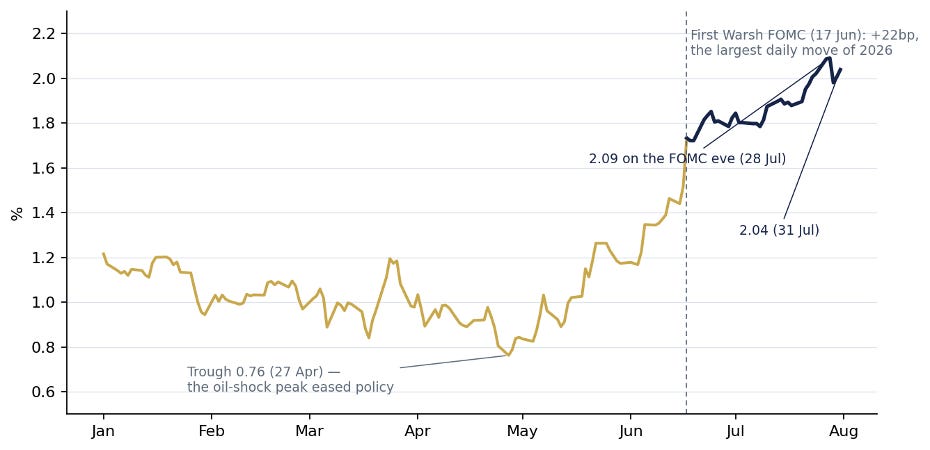
Figure 1 · The 2y synthetic real rate, daily. Gold: pre-Warsh FOMC. Navy: from 17 June. Datastream, to 31 July 2026.
In what follows, I will discuss why the chart above is the best visual representation of the regime shift underway at the Federal Reserve under its new chairman, Kevin Warsh.
Background
Many commentators, journalists, and academic colleagues came away from the July FOMC press conference critical, disappointed, or simply confused. When preparing for it, I expected something similar to the first press conference and his intervention at Sintra. But in reality, at the July press conference, Warsh laid out how he sees the Fed’s role and its interaction with financial markets. Indeed, he emphasized a few times that financial conditions had tightened in the inter-meeting period, and that markets had moved on the data without being guided by the Fed: the increases in market interest rates between FOMC meetings were, he said, “ranking around the top decile or so” of the past two decades, and “the reduction in forward guidance may have been a factor.”
His remarks reminded me of a piece I wrote at the BIS with Boris Hofmann, Galo Nuño and Damiano Sandri (“Quo vadis, r*? The natural rate of interest after the pandemic,” BIS Quarterly Review, March 2024). When reviewing the different ways of thinking about r*, we discussed the possibility that the natural rate, rather than being a purely exogenous guidepost, may itself be shaped by the conduct of monetary policy: the “hall of mirrors” of Rungcharoenkitkul and Winkler (BIS Working Papers no 974), captured empirically in a fascinating paper by Sebastian Hillenbrand (Review of Financial Studies, 2025; see also Hanno Lustig ’s recent Substack extending it). One way to summarise the idea: the Fed guides the expected path of interest rates; markets price that path into the curve; and the Fed then sets, and assesses, its stance against the very curve its own guidance produced. It is monetary policy conducted in front of a mirror.
This is no longer the case, and Warsh made the information rationale explicit: take a useful source of information, add the Fed’s own forecast and rolling commentary, and you “get it all fogged up… we’re going to have less information.” In his prepared remarks, he stressed a key development on which I will focus here: “nominal and real yields are materially higher across the Treasury curve.” His general principle, let markets read the data, “play the ball, not the referee”, provides the lens through which to examine the market’s message along different dimensions (real, nominal and across maturities). This, I will argue, is one of the defining features of the new Fed and the one I will analyze in this series.
The Decision, Financial Markets and the Three Dissents
Last Wednesday’s FOMC meeting produced an interesting combination of outcomes. The Committee left the policy rate at 3½–3¾ percent. Three of the twelve voters (Hammack, Kashkari, and Logan) dissented. According to the statement, they “preferred to raise the target range for the federal funds rate by 1/4 percentage point at this meeting.” The statement, as in June, promised only that “The Committee will deliver price stability.” In the old-regime reading, we would say that Hammack, Kashkari and Logan are hawks who prefer a tighter stance.
Under the new regime, I am not sure this old label works.
A hike by September was priced near 76 percent going into the meeting; a July hike near 38 percent. An immediate hike would therefore have moved the expected path very little, by pulling forward a delivery the market had already built, and, by removing the uncertainty about delivery, it might even have eased conditions at the long end: a nominally hawkish move with a potentially dovish financial consequence. The hold, paired with a hawkish restatement of the rule, is what tightened. In this regime, the information is in the reaction function, not in the level of the rate.1
As I will show shortly, nominal yields rose across the curve; real yields rose by more; and market-implied inflation expectations fell.
My interpretation is that markets adjusted to Warsh after June and started pricing the Fed’s reaction function to the data. The July meeting is the clearest evidence so far of a pattern that first appeared on the 17th of June, when the two-year synthetic real rate jumped 22 basis points in a day without retracing.
To clarify, higher real rates across maturities can reflect different economic forces (stronger growth, higher fiscal risk, and term premia), and, in my interpretation, these factors are complementary. The window I examine, though, is relatively short, and, as I argue, it coincides with a structural shift in the conduct of monetary policy.
In what follows, I will develop three lines of argument: where policy enters asset prices (Hillenbrand’s question: historically, almost entirely inside a three-day window around FOMC meetings); what the market is pricing now (a higher real policy path, on which market commentary is converging); and why the answer to the first question has changed.
One way to interpret the bond market is that it is forcing the Fed’s hand (see, for example, Stephen Innes 🇨🇦 🇹🇭 ’s Substack, 24 July). My reading is different: the market is executing a rule the Fed has stated. We have entered a reaction-function guidance regime.
The rationale
In several pieces on this Substack, I have argued for the importance of understanding the transmission mechanism of monetary policy: how balance-sheet operations and changes in short-term interest rates propagate through the economy and affect the choices of individual agents [see my recent research work Benigno & Benigno, “Managing Monetary Policy Normalization” for an interaction between balance sheet policies and the short-term policy rate]. One aspect I have emphasized in the past is the importance of economy-specific institutional and structural features in assessing the monetary policy transmission. Long-term rates matter more in the United States than in, say, the United Kingdom, where the mortgage market has a much shorter duration.
One of the recent FOMC dissenters has stressed a similar principle. In a series of Minneapolis Fed essays, Neel Kashkari has argued that “the single best proxy for the overall stance of monetary policy” is the long-term real rate, specifically the 10-year TIPS yield (“Policy Has Tightened a Lot. How Tight Is It?”, 2023; updated 2024). His reasoning centers around the transmission point: a long rate embeds the expected path of both the funds rate and the balance sheet, so it prices the full policy package rather than a single instrument; and it deflates by expected future inflation rather than recently realized inflation, the relevant deflator for the forward-looking decisions of households and firms, who borrow at these rates, not at the overnight rate.
Looking at Kashkari’s own gauge, then, the stance has tightened by roughly 70 basis points from its late-February low, and about 45 basis points year-to-date, without a single short-term hike. My interpretation, within the new regime, would rationalize his dissent to the extent that the neutral rate has also risen, so that he would like to see a real rate higher than the neutral one.2
But, let me now examine the financial market data along these lines, following the Chairman’s own remarks, focusing not only on nominal yields but also on real ones, at the short end and across maturities.
TIPS do not exist at one- and two-year maturities, so I build a synthetic real rate at each maturity (the nominal benchmark yield minus the matched zero-coupon inflation swap, r(m) ≡ y(m) − s(m)) and read every move through the identity Δy = Δr + Δπᵉ.3
What the data show
Figure 1 plots the two-year synthetic real rate; Figure 2 plots synthetic real rates at several maturities from January 2026, and I think there is a lot of information in them. From January to late April, the oil shock eased policy in real terms: expected inflation surged while the expected policy path barely moved, and the 1-year rate (Figure 2) touched 0.19 percent at the peak of the inflation scare, an essentially zero real policy rate at the moment inflation risk peaked. This is consistent with the presence of the easing bias in the pre-Warsh FOMC statements. The 2-year rate began recovering in late May, around the time Warsh took over, but the structural break comes at his first meeting: 22 basis points on decision day, on the 17th of June, with no retracement, and a further climb to 2.09 percent on the evening of the July meeting, falling to 1.98 percent on the decision day and back to 2.04 percent by the 31st of July. The role of meeting days changed too: decision days, which had leaned against the move earlier in the year, began contributing to it.
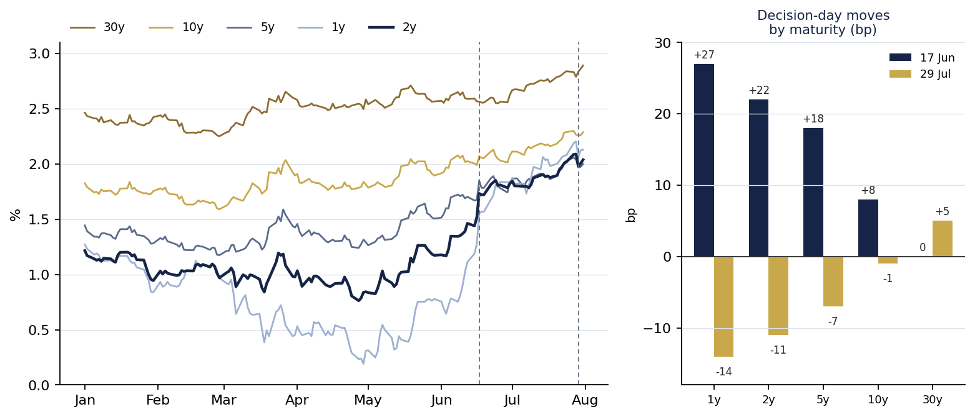
Figure 2 · Five maturities, and the decision-day moves by maturity: 17 June and 29 July.
Figure 2 is useful because competing explanations carry different implications for the maturity profile. If the June repricing had mainly reflected term premia or fiscal risk, the long end should have moved at least as much as the front. Instead, the 17 June move was +27 bps at one year, +22 at two, +18 at five, +8 at ten, and zero at thirty. The long end barely moved. The 29 July profile is the mirror image: −14bp at one year and −11 at two, as the residual probability of an immediate hike and the double-hike tail dropped out, fading to +5 at thirty, again monotone toward the long end, this time from below. Meeting days move the maturities that embed the policy path, in whichever direction the rule’s reading requires. I think the June decision provides supporting evidence: the front of the real curve repriced expected policy, while the long end (whose rise began in late February, before the shock, and which was barely responsive to the meetings — zero on 17 June, and +5bp real on 29 July, with most of that day’s 30-year move in breakevens) was pricing something else, which I might discuss in a follow-up note.
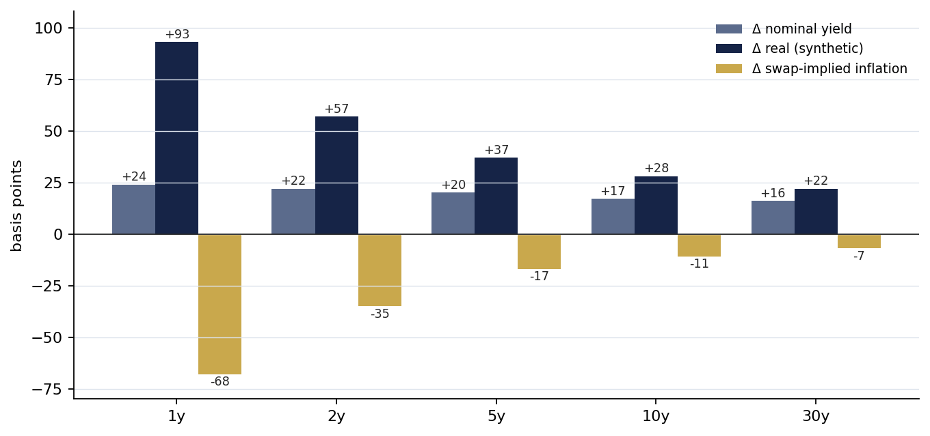
Figure 3 · 16 June → 28 July, the full inter-meeting window: the nominal move decomposed. Expected inflation fell at every maturity.
The inter-meeting decomposition points the same way. Over the full inter-meeting window, nominal yields rose 16–24bp across the curve; real rates rose 22–93bp; swap-implied inflation fell at every maturity, by 68bp at the front, while the 30-year swap held a 20bp range for the entire year. As a result, more than the whole nominal move is real. My interpretation is that the market is not pricing inflation into Treasuries; it is pricing a central bank that is no longer validating disinflation with easing. One important qualification: part of the front-end rise reflects expected inflation falling on the post-ceasefire energy round-trip, rather than the rule alone. This would imply that the rule’s component shows up separately, in the expected nominal path (the 1-year OIS rate rose 23bp over the same window) and in the decision-day profiles of Figure 2.
Reaction-function guidance
Why, then, would real rates rise while the Fed holds?
Consider the starting situation: the US economy has experienced sixty-three months of above-target inflation, with core PCE at 3.3 percent and rising on the staff’s own estimate, and a Fed that has held rates steady twice into it. Under the previous communication regime, a policy path pinned by forward guidance was consistent with a procyclical stance: inflation rose, the expected path stood still, and the real rate fell. Policy effectively eased into the shock. That was the experience of January–April 2026, when the market priced the shock as transitory against an unmoving path, as it had been in 2021. Under the current regime, the market is pricing the reaction function. Rising underlying inflation raises the expected path ahead of any decision on it: the conditional hike is priced rather than delivered, with the real rate rising while the funds rate does not move. In my schematization below, I refer to this hold as state-contingent delivery, passive tightening. (Bailey at the Bank of England has spoken of an active hold: “The right decision today is to hold, but it’s an active hold… It’s not a passive wait-and-see hold.”)
To be concrete, consider how this plays under the current high-inflation state. The latest good news on CPI is downplayed (i.e., “a single month of modest price decreases”) because what matters are the trends, not the points. Hot underlying news is different: it moves the priced path right away. The Chairman put the rule on the record himself: “Any central banker, when he or she sees underlying inflation moving higher, he or she is more inclined to tighten policy… That’s my reaction function.” This is also what the pricing suggests: throughout the month, the probability of a September hike ranged from 58 to 82 percent. I would argue that the reaction function is asymmetric. Let me explain. Soft news faces a high bar; hot news a low one; in fact, no equivalent one-month discount was offered for upside surprises. The same type of news moves the expected path differently depending on its sign. A framework like that works like a ratchet: the priced path rises on bad news and does not come back down on good news. The inter-meeting data shows it. Expected inflation fell 68 basis points at the front (the soft CPI, largely energy-driven) while the expected nominal path rose 23. Under a symmetric rule, falling expected inflation would have pulled the path down with it. The real rate therefore rose through both terms of the identity at once (the path in the numerator, expected inflation in the deflator), and it is the asymmetry that lets both move in the tightening direction at the same time. As Warsh put it: “There is no soft inflation target, there is no soft implicit target — not on this Committee’s watch. There is only a target, and it is 2 percent.”
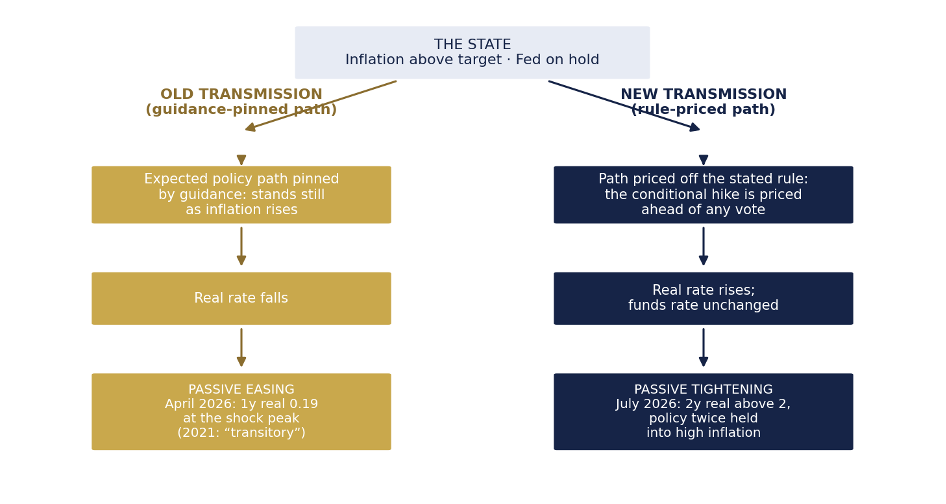
Figure 4 · The same state — inflation above target, policy on hold — run through two transmissions.
The old Fed communicated future policy, and the market priced the curve. The new Fed communicates a rule (i.e., “play the ball, not the referee”) and the market builds the curve itself. In Warsh’s words, “the central bank need not always and everywhere be the center of attention.” If these first two meetings are representative of what is to come, we have entered a different operating regime: I refer to it as reaction-function guidance. Figure 4 represents the discussion graphically: the state is the same, inflation above target and policy on hold; what changed is the reaction function the market is pricing.
One way to test this claim is to examine when yields have moved. Hillenbrand (2025) documents that the three-day windows around Fed meetings capture the entire secular decline in 10-year yields from 1989 to 2021, roughly 87 percent of a seven-point fall, while some 7,200 non-meeting days cumulate almost nothing. One way to summarise his finding: the market waited for the Fed to interpret the data. That world was already changing before Warsh. Following Hanno Lustig, I re-ran the decomposition on official announcement dates up to last week: since the March 2022 QT announcement, non-meeting days account for +358bp of the 10-year’s rise while the meeting windows cumulate to −106bp. Price discovery occurred outside the FOMC window before the new Chairman arrived.
What is new in 2026 is what the meeting windows do, and this is where I focus, looking at the 2-year synthetic real rate and splitting the year at mid-June. From January to mid-June, meeting windows contributed −14bp while data days contributed +36bp: the meetings leaned against a tightening the data kept delivering. From Warsh’s first meeting, the contribution flips sign: +20bp across his two windows against +40bp on data days — a +28bp repricing at the June window, and a small −8bp at the July window, which is what validation looks like when the market has already read the rule. Meetings reprice the rule; data days apply it. Two windows are still a small sample, but the sign flip of the meeting-window contribution under the new chairmanship is an interesting statistic to note for now.
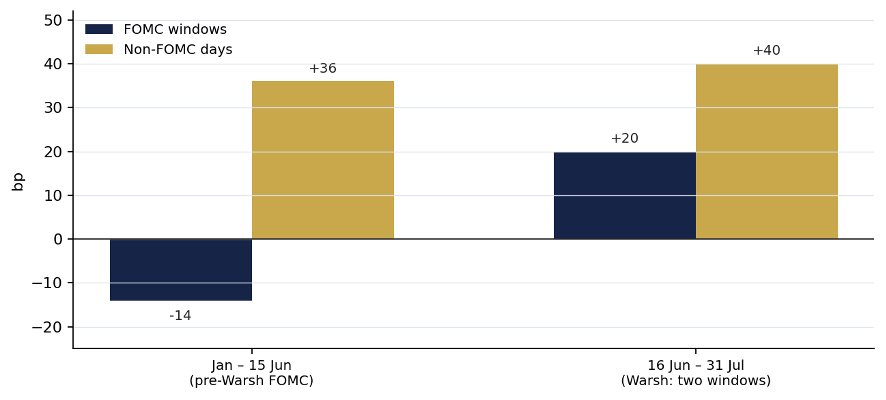
Figure 5 · 2026’s 2y-real move split by meeting windows, before and after the first Warsh FOMC.
Once the communication regime changes, the way yields respond at meetings changes with it, so previous historical relationships need no longer hold. That is a version of the Lucas critique applied to central-bank communication. Previously the sequencing ran from macro data to Fed interpretation to market prices; now it runs from macro data to the market’s expectation of the Fed, which the Fed then validates or corrects. The interpretation has shifted from the Fed to the market. What has not shifted is the decision or the authority: the Committee still decides, but it decides against a market reading that it did not dictate. Warsh drew the same line himself: “we’re not going to be constrained by market prices” and markets are “a very good source of information, not a determinative source.”
All this relies on an internal condition of the regime. The market prices in one rule, but the FOMC decision is based on twelve votes. Reaction-function guidance holds only for as long as Warsh carries the core of the Committee, as long as the rule he states and the rule the median voter delivers coincide. For now the July record supports coincidence: “overwhelming agreement on objectives and authority, and commitment,” in the Chair’s description, with the dissents reflecting a disagreement about timing inside that agreement.
Revisiting the Fed’s July hold
Let us now review the July decision against this regime. If markets are pricing the reaction function, why did the Fed not simply raise rates in July? Because in this framework the hold was the rule’s output, and the market had priced it that way ahead of the meeting. A July hike was priced near 38 percent going in; a hike by September near 76: the modal priced path was hold now, deliver later. The hiking trigger, as stated and as priced, is a confirmed rising trend in underlying inflation, not any single print; on my reading, the trigger was not yet met, and the July and September pricing reflected exactly that.
Hiking in July would have added further stance on top of the market-delivered stance; the two-year real rate was already above two percent, and a hike would have surprised a market that had priced the hold, which under this regime would itself have been evidence of a rule the market had misread. This is why the meeting still mattered: its job was to validate the market’s reading of the reaction function. Warsh described the deferral logic in his own words: markets “have tightened financial conditions in this intermeeting period,” giving the Committee “some comfort” about “the ability and capability to deliver.” And the measured outcome looks like validation. A hold, three dissents and a hawkish press conference moved the September probability, conditional on the July hold, by about three points. Under the old regime that combination would have been a major event; under this one it moved almost nothing, because there was almost nothing to correct.
None of this is definitive, of course, and September will be the more interesting meeting. The hold proves nothing yet. An alternative interpretation is that the chairman is simply too tolerant of inflation: a trend is something you can wait for indefinitely. Each individual print gets its own explanation (energy, one soft month, a quirk in the data), the bar for “confirmed” keeps receding, and a rule that never triggers is indistinguishable from having no rule at all. That is how central banks have historically fallen behind the curve: one reasonable exception at a time. The regime’s reading is different: this is a deferred, state-contingent delivery. The two interpretations are observationally identical today. They separate at the first confirmed trigger. If underlying inflation keeps rising and September delivers, the July hold was the rule operating. If it keeps rising and September holds again, the July hold retroactively becomes the tolerance story, and I suspect the market’s reaction would show up as inflation breakevens rising while real rates fall, the exact reverse of the recent pattern, as the market takes back the tightening it had extended earlier.
The regime works…until it doesn’t
Everything above rests on one input. Today’s measured tightening is ex-ante (the nominal path minus expected inflation), and the front swap is pricing a complete disinflation: roughly 2 percent CPI over the coming year, which via the usual wedge corresponds to below target on the Fed’s own index (with the caveat that the front swap still carries the energy price effect). If inflation comes in on that path, the tightening was real. If it prints 3.5 percent where the swaps had priced 2 percent, the ex-post real rate was low all along. The restriction never reached the economy. The Fed has, in effect, borrowed today’s tightening from tomorrow’s inflation outcome.
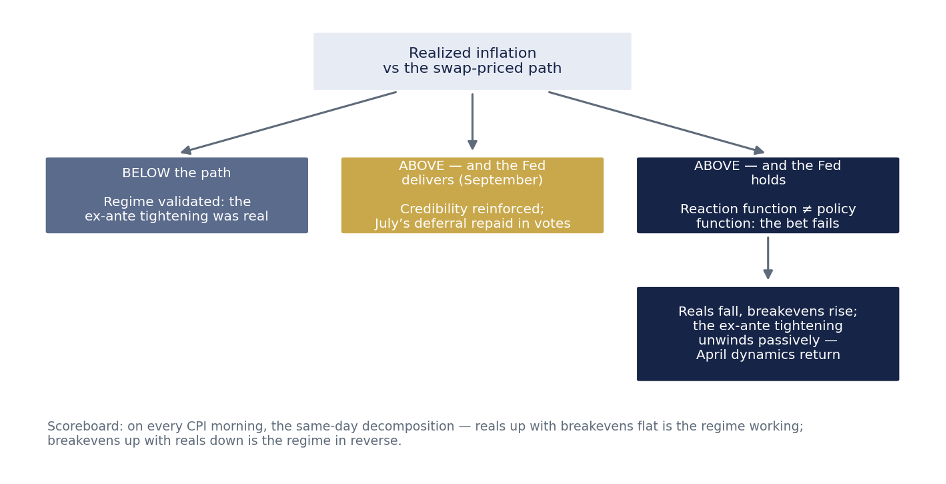
Figure 6 · The stress test.
An upside surprise in inflation resolves one of two ways. If the Fed delivers in September, when the market prices a hike near 67 percent as of end-July, the deferred tightening is locked in by the voting committee, and the regime turns out to re-sequence conventional policy rather than replace it. If the Fed holds into the surprise, the logic runs in reverse: the market stops raising the priced path on inflation news, swaps reprice up, and rising expected inflation eats the real rate; the stance passively eases just as inflation re-accelerates. April’s dynamics would return, but with the Fed’s credibility depleted.
Where would the surprise come from? Probably not the energy price level, which the front swap has already priced. On my reading, and in earlier analysis on this Substack (The Return of Non-Linear Inflation: Part I), the risk runs through supply-chain propagation into core: the persistent channel that the Global Supply Chain Pressure Index, which I helped develop at the New York Fed, was built to isolate from temporary bottlenecks.
To sum up, the assessment of the regime is relatively simple from a financial-market point of view: real rates up with breakevens flat is the regime working; breakevens up with real rates down is the regime in reverse.
What September settles, and what it doesn’t
The interpretation offered here may turn out to be wrong. Two meetings are not a regime; two meeting windows are a small sample, and several of the forces behind higher real rates (the equilibrium rate, the fiscal premium) are relevant elements that I will take up in the pieces that follow. But the pattern, together with Warsh’s press conference, is enough to motivate a different question. Perhaps the variable that matters is no longer whether the Fed changes the policy rate, but whether markets believe they understand the rule that governs it. September will not answer that question definitively. It will provide the next observation.
Conclusions
If this conjecture is right, we have entered a very interesting period for monetary policy, and a set of new questions opens with it, because under this regime the behaviour of financial markets acquires consequences beyond the intended transmission of policy. A natural one concerns the resistance points of this new arrangement. I have mentioned the internal FOMC dynamic as the obvious institutional one. A highly financialized US economy, in the middle of an AI euphoria, may prove to be the economic one.
References
• Benigno, G., B. Hofmann, G. Nuño Barrau, and D. Sandri (2024). “Quo vadis, r*? The natural rate of interest after the pandemic.” BIS Quarterly Review, March 2024.
• Rungcharoenkitkul, P., and F. Winkler (2021). “The natural rate of interest through a hall of mirrors.” BIS Working Papers, No. 974.
• Hillenbrand, S. (2025). “The Fed and the Secular Decline in Interest Rates.” Review of Financial Studies, 38(4), 981-1013.
• Lustig, H. (2026). “What Happens to Yields in Between FOMC Meetings?” The Two Cents, 30 July 2026.
• Benigno, G., and P. Benigno (2026). “Managing Monetary Policy Normalization.” The Economic Journal.
• Kashkari, N. (2024). “Policy Has Tightened a Lot. How Tight Is It?” Federal Reserve Bank of Minneapolis, 5 February 2024.
• Kashkari, N. (2024). “Policy Has Tightened a Lot. How Tight Is It? (An Update).” Federal Reserve Bank of Minneapolis, 7 May 2024.
• Innes, S. (2026). “The Bond Market Is Forcing the Fed’s Hand.” Investing.com, 24 July 2026.
• Board of Governors of the Federal Reserve System (2026). FOMC press conference transcript, 17 June 2026.
• Board of Governors of the Federal Reserve System (2026). FOMC press conference transcript, 29 July 2026.
• Bank of England (2026). Monetary Policy Report press conference transcript, April 2026.
This interpretation holds as long as a hike is understood as a change of timing rather than a change of the factors that trigger it.
For now I will not discuss the implications of the new regime for the neutral rate; I will return to this in a follow-up piece
Two caveats. Inflation swaps reference CPI while the Fed’s target is PCE, so the exercise is imperfect as a reading of distance from the declared target. And the synthetic measure bundles the true real yield with liquidity and term premia, even though where TIPS do exist (5, 10 and 30 years), they read at a stable 13–15 basis points above the swap-implied measure on the dates I use, so the changes, which are what I focus on, are robust to the basis.
Excellent Gianluca! Happy to see a sensible dissection of Warsh's communication.
The rule-priced regime only holds if the Fed actually delivers in September — a hold into an inflation surprise would flip the sign right back, and market pricing alone can’t tell us yet which one wins.